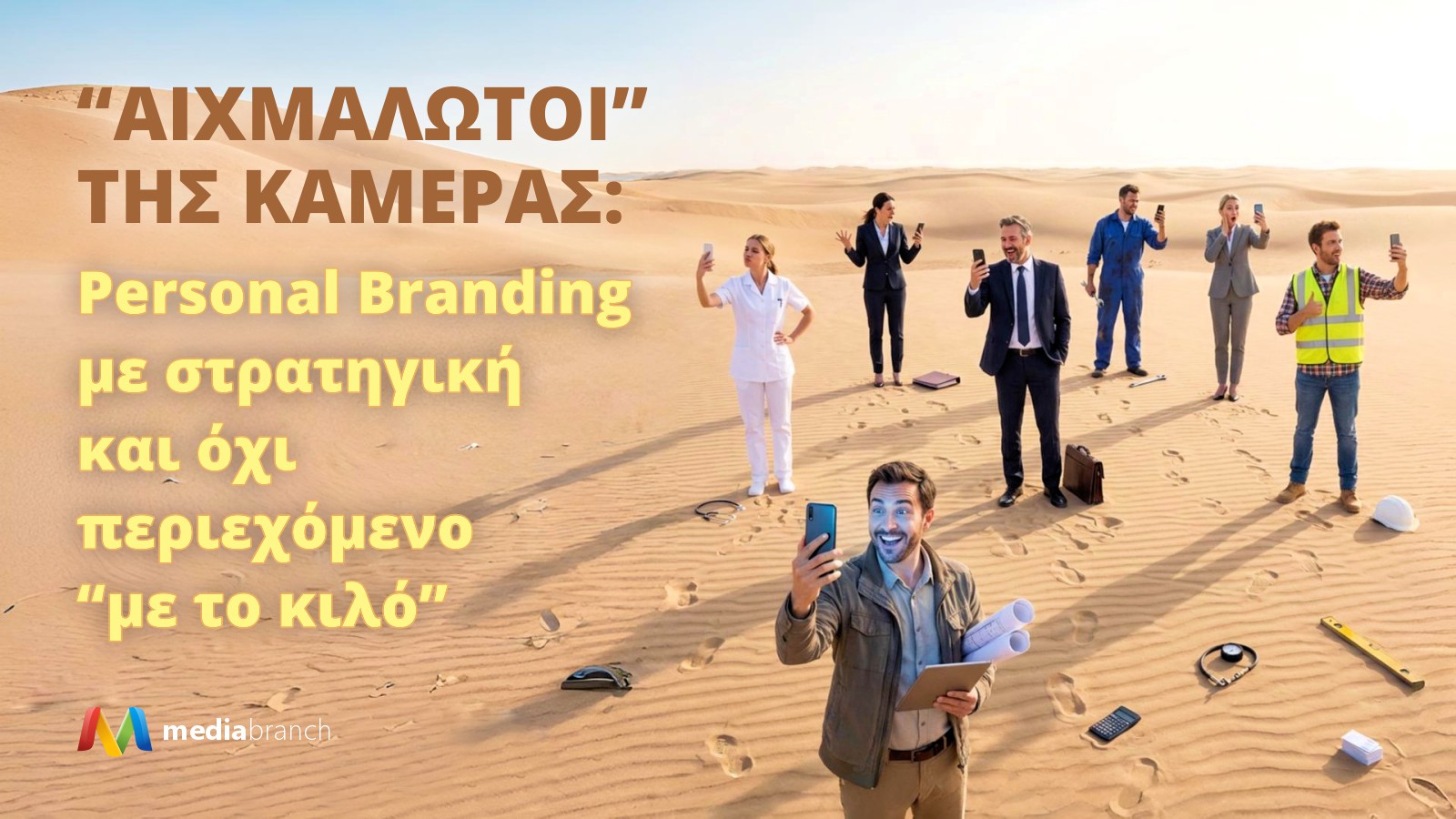
In recent years, the concept of Personal Branding has been trapped in a single-issue and often flat-out advice: “"If you don't make videos, you don't exist.". This perception has turned Digital Marketing into an arena of impressionism, creating a generation of professionals who feel “captive” to the camera. In their attempt to fit decades of experience and expertise into 60-second Reels, they end up following trends that often undermine their prestige instead of enhancing it.
In MediaBranch, we believe that Personal Branding is strategy, not format. When we say format, we are referring to means of expression that you choose, whether it’s a video, an article, or an infographic. The format is simply the “package.” If the content of the package is not valuable, no medium, no matter how popular it is today, can build a sustainable brand.
Where does Video work and where does the “Depth” Strategy work?;
The choice of medium should not be based on what is “fashionable”, but on the basis of decision architecture of your customer. Don't be afraid to be analytical. The right client, the one who is going to seriously invest in you, doesn't just want to "see" you in a quick glance across their screen, they want to read you, study you, and understand how you think.
OR Strategy of Depth is our answer to the noise, it is the choice to offer content that educates and demonstrates your expertise, rather than seeking a fleeting impression.
- When energy is the product (Branches of Personal Motivation): In areas such as Mentoring, the Coaching or the Creative Services, video is irreplaceable. Why? Because the customer is not just buying a solution, they are buying you. Body language, tone of voice and your ability to inspire are “proofs of competence”. Here, video reduces distance and creates an emotional bridge before the first meeting even takes place.
- Business Consulting & B2B Strategy (Rational Decision Making): In the B2B environment, decisions are made based on ROI (Return on Investment) and risk management. A CEO or a Decision Maker will not trust you because you made a viral video. They will trust you because they read an analysis (Whitepaper) that proves that you understand the challenges of their industry. Here, the robustness of the written word it offers the depth that short video often fails to reach.
- Scientific Branches (Law, Medicine, Finance): In these areas, overexposure to “trendy” videos can have a negative effect, creating a sense of “lightness.” Video here should be used as a “Digital Handshake”, short, serious and reassuring. However, the real selling is done through Case Studies and scientifically documented articles that allow the customer to refer to them again and again, building a sense of security.
The Persistence of Marketers: What's Behind the Pressure for Video?;
To protect your business, you need to understand why the market is pushing you in a certain direction. Often, insisting on “video-only” strategies hides three pitfalls:
- The Hunt for “Vanity Metrics”: Marketers love impressive numbers: “100,000 views.” But views are not sales. It’s much easier for an agency to show you a report with hearts and likes than to explain how 100 quality readers of an article can bring in 10 high-value contracts. Vanity metrics feed the ego, but often leave the coffers empty.
- The Trap of Internal Specialization: Many modern agencies are staffed with video editors and social media managers, not strategists or experienced copywriters. Their advice will always be “make a video,” not because it’s the best for you, but because it’s the only product they have on their “shelf.”.
- The Ease of the Surface: Finding a trending audio and asking a client to make a video is a fast-food marketing process. Writing an article that will establish a professional as Thought Leader it requires research, strategic data analysis, and intellectual effort.
Many marketers choose the “autopilot” solution because it requires the least amount of time and effort on their part. In practice, this means:
Instead of strategy, “trends”: It's much easier to be told to "put on that viral sound" than to sit down and study the psychology of your audience and how your business generates profit. Trends are the "fast food" of marketing: they offer instant gratification through views, but no "nutritional value" for the sustainability of your brand.
Instead of personalization, content “by the kilo”: They apply the exact same formula to a lawyer and a CEO, because it is much more profitable for the agency to use “prefabricated molds” rather than creating a unique strategy from scratch. If your communication is based on ready-made solutions that are given to anyone, then you are not building Personal Branding, but simply adding your name to an endless series of identical, uninteresting posts.
Avoidance of mental work: Writing an article that convinces an investor or partner requires deep market knowledge, critical thinking, and hours of work on the structure of the arguments. In contrast, producing a 20-second video with a common catchphrase or a thousand-word phrase is “produced” in a few minutes. It keeps you “busy” with the hunt for publicity, but it doesn’t build the intellectual capital that a professional needs to be considered an authority in their field.
This approach may fill your profile with material, but it rarely fills your coffers with clients.
The “Owned Land” Strategy: The Foundation of Digital Property.
This is perhaps the most important concept we espouse at MediaBranch. In the digital world, there are two types of property:
- Rented Land (Social Media): LinkedIn, Instagram, and TikTok are “rented.” You are the guest of an algorithm that can change the terms of the contract without notice. If your strategy is based solely on Reels, you are building a castle in the sand. When the algorithm changes (and it always does), reaching your audience will require more and more advertising money.
- Owned Media: Your Blog, Newsletter and Whitepapers are your own land. It is the place where you set the rules and, most importantly, where you build the first-party data In a world where social media algorithms change daily, owning your own data (like your contact lists and reader behavior) is the only real guarantee that your business won’t be left “homeless” if a platform decides to limit you.
- Lifetime: A Reel “dies” in 48 hours. A strategic article on your site has a “lifespan” of years and continues to bring in leads through Google’s organic search results.
- Ownership of Data: In your own land, customers become subscribers (emails/newsletters), not just “followers.” This turns your content from exit (such as paid ads or disposable “one-time” posts) in a digital asset which increases the objective value of your business.
Modern Success Stories: The Power of Authentic Choice
To understand that success does not require "dancing" on camera, we only need to look at people who dominate today, at their most productive age:
- James Clear: The author of Atomic Habits He didn't become famous for Reels. He became a global brand by writing a newsletter with crystal clear thinking. Even today, his social media presence is based on screenshots of texts. He proved that the purity of the idea is more attractive than any visual effect.
- Justin Welsh: The man who decode LinkedIn's strategy. He started from scratch after a burnout and built a multi-million dollar business based on simple, Doric texts. His success came because he brought order to the chaos of his readers, using the written word as a tool of absolute persuasion.
- Joe Pulizzi: The “private land” general: While most people in the past decade have been blindly investing in building audiences on third-party platforms, Pulizzi consistently warned: “Don’t build on rented land.” He used social media only as a channel to drive audiences into his own ecosystem. Focusing on Data Ownership, created a digital asset with such a strong database that in 2016 it was acquired for $28.4 million. Pulizzi's case remains the leading example of how content is transformed from an expense into a business with huge resale value.
Branding Check: Which path suits you?;
Before investing time and money in your next campaign, evaluate your position:
- The nature of the service: Does it need logical analysis (text) or emotional appeal (video)?;
- The client's framework: Where is he when he looks for me? If he's in the office looking for a solution for his company, an article is more professional than a TikTok.
- Viability: Can I sustain video production for the next 2 years without burning out? If not, start with the written word.
- Authority: Do I want to be remembered for a viral joke or for my deep knowledge on a problem?;
The Golden Ratio Strategy: MediaBranch's Hybrid Model
You don't have to choose a side. The solution lies in “Hybrid Model”:
- Step 1: You create a High-Quality Content (an in-depth and analytical article or Case Study) on your own land.
- Step 2: You break it down into small pieces (infographics, short texts) for the rented land of social media.
- Step 3: Use social media as "magnets" that drive the audience back to your site, where the sale is made on your terms.
The MediaBranch philosophy
Marketing should be a natural extension of your professional integrity. Our mission is to help you build a brand that is not based on the fear of the algorithm, but on the power of your value. Because at the end of the day, the customer doesn't buy content, they buy certainty.
Are you continuing to build on "rented land" or is it time to get your own?; If you want us to design together a strategy that combines the immediacy of today with the timeless value of tomorrow, The MediaBranch team is here to guide you.